The Complete Georgia Grower’s Guide to Planting Pecan Trees
The Complete Georgia Grower’s Guide to Planting Pecan Trees
Alright neighbors, let’s talk about pecans. Here in Forsyth County, Georgia, planting a pecan tree is more than just a bit of landscaping; it’s an act of faith. You’re putting a sapling in the ground that could outlive you, your kids, and maybe even your grandkids. Getting it right from day one isn’t just a good idea—it’s the difference between a century of delicious pies and a lifetime of battling pests, diseases, and disappointment. This guide is your roadmap, built on solid science from the University of Georgia Extension and seasoned with the hard-won experience of farming right here in our unique corner of the world.
Key Takeaways
- Variety is Everything: Your single most important decision is choosing a pecan variety. Selecting a cultivar with proven resistance to pecan scab, like ‘Elliott’ for a yard tree, will save you immense time, money, and frustration in Georgia’s humid climate.
- Site Prep is Non-Negotiable: Pecan trees demand well-drained soil and will fail in “wet feet.” You must ensure your planting site has deep, workable soil, avoiding areas with a high water table or compacted Georgia red clay that hasn’t been properly amended.
- It’s a Marathon, Not a Sprint: A pecan tree requires a long-term commitment to a specific fertilization and pest management plan. You can’t just plant it and forget it; you must actively manage its nutrition (especially Nitrogen and Zinc) and monitor for key pests like the pecan weevil, following a calendar tailored for Georgia.
The Deep Dive
Why Pecans are a Georgia Legacy (and a Worthy Challenge)
Pecans are woven into the fabric of Georgia. They’re a symbol of Southern hospitality, a staple of holiday baking, and a cornerstone of our state’s agricultural identity. But let’s be honest—growing them successfully, especially here in the northern half of the state, isn’t as simple as sticking a tree in the ground and waiting for the nuts to fall.
Our infamous red clay can be a challenge, and our summer humidity is a five-star resort for fungal diseases, particularly the dreaded pecan scab. The good news is that it’s entirely possible to grow beautiful, productive pecan trees here. It just requires a plan. You’re not just a gardener; you’re the steward of a long-term investment. Let’s build that investment on a solid foundation.
Choosing Your Champion: The Right Pecan Variety for Forsyth County (Zone 8a)
I cannot overstate this: Choosing the right variety is 90% of the battle. The University of Georgia (UGA) Extension has spent decades testing cultivars to see which ones can withstand our specific disease and pest pressures. Fighting pecan scab with a susceptible variety is an expensive, frustrating, and often losing battle.
Your choice depends on your goal. Are you looking to sell nuts and maximize yield, or do you just want a beautiful shade tree that provides a yearly bounty for your family?
-
For the Low-Input Homesteader or Yard Tree: If you want a tree that requires minimal spraying and fuss, your choices are clear. These varieties have excellent natural resistance to pecan scab.
- ‘Elliott’: This is a fantastic choice for a yard tree in Georgia. It has excellent scab resistance, produces a smaller but high-quality nut, and has a sturdy structure. It’s a reliable producer that won’t break your back with maintenance.
- ‘Gloria Grande’: Another highly scab-resistant variety that produces a large, high-quality nut. It’s a vigorous grower and a great option for a low-maintenance approach.
- A Note on Pollination: Pecans are wind-pollinated and have two “types” of flowering patterns (Type I and Type II). For consistent nut production, you need at least one of each type planted within about 200 feet of each other. ‘Elliott’ is a Type II, and ‘Gloria Grande’ is a Type I, making them excellent partners.
-
For the Serious Grower or Small-Scale Commercial Orchard: If you’re committed to a full spray program and want to maximize your yield of large, marketable nuts, UGA recommends several high-performance cultivars. These often have better yield or larger nut size but will require diligent management to control scab.
- ‘Avalon’: A newer UGA release with good yield potential and better-than-average scab resistance for a commercial type.
- ‘Pawnee’: An early-maturing variety that produces a very large, high-quality nut. It is, however, susceptible to scab and requires a rigorous spray schedule.
- ‘Oconee’: Another popular choice that produces large nuts with good kernel quality. Like ‘Pawnee’, it needs a dedicated disease management program.
The Bottom Line: For most folks in Forsyth County just wanting a tree for their property, stick with the low-input varieties like ‘Elliott’. You’ll be much happier in the long run.
Location, Location, Location: Site Selection Done Right
A pecan tree can live for over 100 years. Where you plant it is a permanent decision. Get it wrong, and the tree will never thrive.
- Sunlight and Airflow: Pecans need full sun. And in Georgia, that means all day sun. But just as important is air circulation. Planting in a low-lying area with stagnant, humid air is an open invitation for fungal diseases. Choose a spot on high ground or an open area where the breeze can move freely through the canopy and dry the morning dew from the leaves.
-
Soil and Drainage: The Most Common Point of Failure: This is where many Georgia pecan dreams die. Pecans have a deep taproot and absolutely despise “wet feet.”
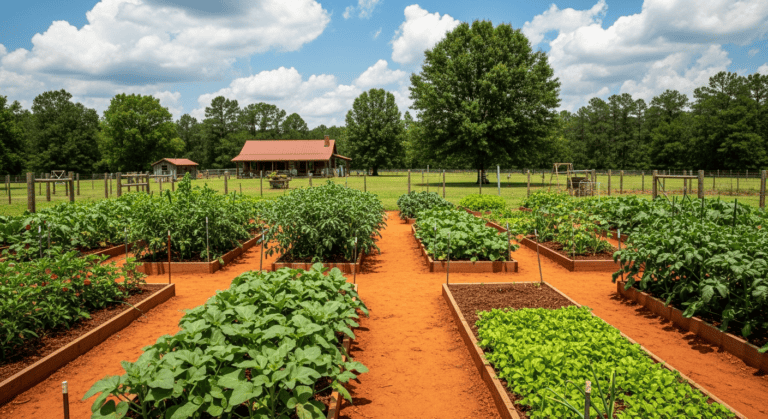
- The Ideal Soil: The textbook answer is a well-drained sandy loam, which is not what most of us are blessed with in Forsyth County. We have clay.
- The Drainage Test: Before you even think about buying a tree, dig a hole about two feet deep where you plan to plant. Fill it with water and let it drain completely. Fill it again and time how long it takes to drain. If it takes more than 12-24 hours, your drainage is poor, and this is not a suitable site without significant modification.
- The Water Table Rule: The UGA Extension is clear: avoid any area where the water table is less than 6 feet below the surface. A high water table will stunt the tree’s root system, making it vulnerable to drought and preventing it from reaching its full potential.
-
Spacing for the Future: It’s hard to imagine when you’re planting a 5-foot whip, but a mature pecan tree is a giant, with a canopy spread of 60-80 feet. Planting too close to your house, septic lines, or other trees is a recipe for future disaster. A minimum spacing of 60 feet between trees is recommended, and 80 feet is even better. Give them room to become the magnificent specimens they are meant to be.
Planting Your Pecan: The Foundation for a Century of Nuts
The best time to plant a bare-root pecan tree in Georgia is during its dormant season, from December through March. Container-grown trees can be planted year-round, but planting one in the heat of a Georgia July or August requires a heroic commitment to watering.
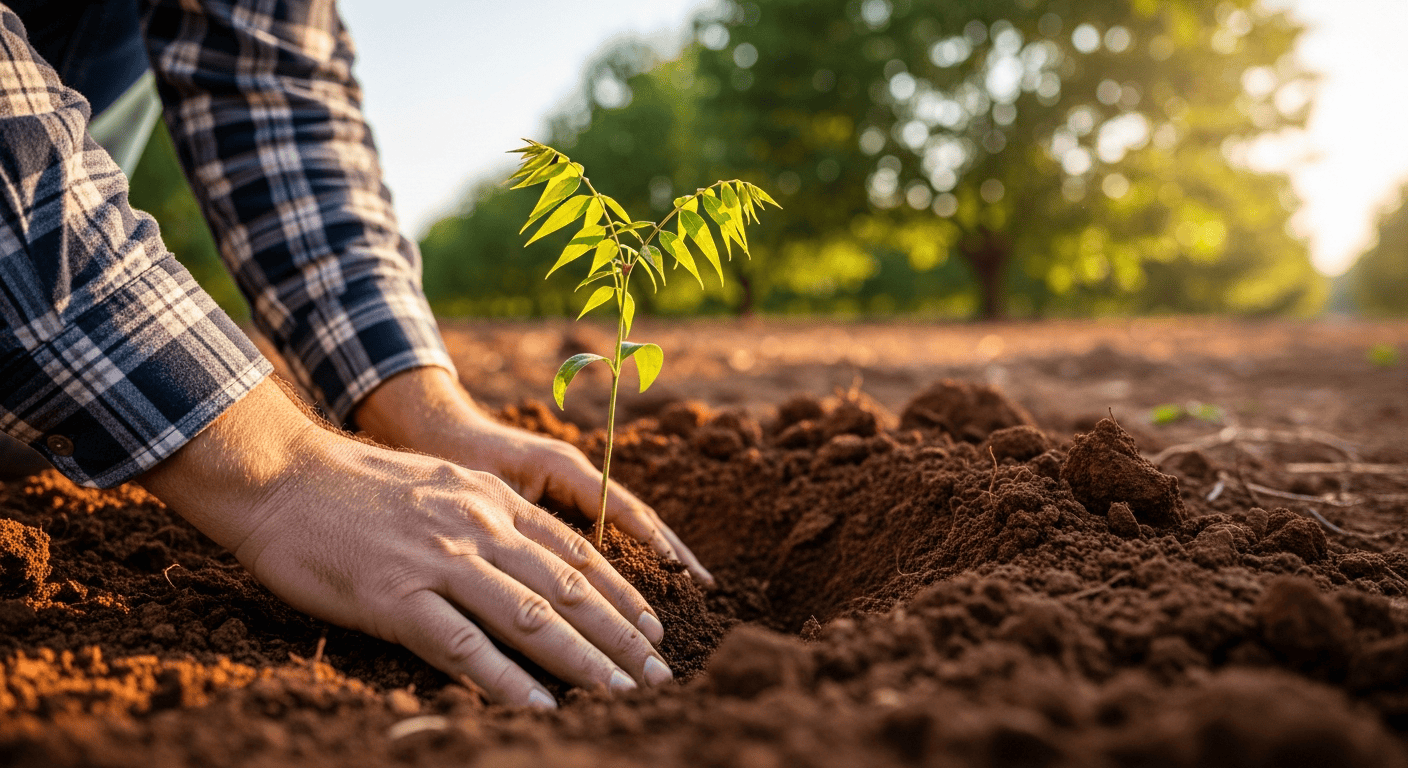
- Dig a Proper Hole: Forget the old advice about digging a $100 hole for a $10 tree. The modern recommendation is to dig a hole only as deep as the root ball and about twice as wide. The goal is to give the lateral roots room to expand into loosened soil.
- Don’t Amend the Backfill: This is controversial but critical. Resist the urge to fill the hole back up with rich compost and potting soil. This can create a “pot effect” where the roots are content to circle inside the nice soil instead of venturing out into our native Georgia clay. It’s better to backfill with the native soil you removed, breaking up any large clods. This forces the tree to adapt to its permanent environment from day one.
- Set the Depth Correctly: This is crucial. Identify the graft union on the tree—it’s a diagonal scar near the base where the desirable variety was grafted onto the rootstock. This union must be at least 2-3 inches above the final soil line. Planting too deep is a common and fatal mistake. The tree should be planted at the same depth it was growing in the nursery. After backfilling, create a small berm of soil around the edge of the planting hole to form a watering basin. Water thoroughly after planting to settle the soil and eliminate air pockets.
Feeding Your Giant: A Georgia-Specific Fertilization Plan
You wouldn’t expect a high-performance athlete to compete without proper nutrition, and the same goes for a productive pecan tree. Fertilization is not guesswork; it’s a science.
- Start with a Soil Test: Before you apply a single granule of fertilizer, get a soil test. Your local Forsyth County UGA Extension office can provide you with a kit and instructions. This test is the only way to know your soil’s pH and existing nutrient levels. Pecans prefer a soil pH between 6.0 and 6.5. A soil test will tell you if you need to apply lime to raise the pH.
- The Big Three Nutrients:
- Nitrogen (N): This is the engine of growth. For young, non-bearing trees, a balanced fertilizer like 10-10-10 is sufficient. Apply 1 pound per year of the tree’s age (up to 25 pounds per tree). For mature, bearing trees, the timing is critical. UGA recommends applying Nitrogen in the spring. A second application may be needed in an “on” year (a year with a heavy nut crop) to support kernel development, but this second application should be skipped in an “off” year (a light crop) to avoid excessive vegetative growth.
- Zinc (Zn): Zinc is a critical micronutrient for pecans, essential for leaf and shoot growth. A classic sign of Zinc deficiency is small, yellowed, “rosetted” leaves at the tips of branches. Zinc is best applied as a foliar spray directly on the leaves in the spring as they are expanding. Soil applications are less effective in our Georgia soils.
- Potassium (K): Potassium is the “health” nutrient. It’s vital for moving carbohydrates (the energy for nut filling) and for helping the tree withstand the stresses of drought and winter cold. A soil test is the best way to determine if your Potassium levels are adequate. Maintaining a proper balance between Nitrogen and Potassium is key to tree health and nut quality.
The Uninvited Guests: Managing Pests and Diseases
Living in Georgia means accepting that we share our environment with a host of insects and fungi. For pecan growers, a proactive and vigilant management plan is not optional.
-
The Arch-Nemesis: Pecan Scab: This fungal disease is the single greatest threat to pecan production in the humid Southeast. It infects leaves, twigs, and the shucks of the nuts, causing black spots and leading to premature nut drop and poor quality.
- Your First Defense: As mentioned before, planting a resistant variety like ‘Elliott’ is the most effective strategy.
- Sanitation: In the winter, clean up and destroy all fallen leaves and shucks. This reduces the amount of fungal spores that can overwinter and re-infect the tree in the spring.
- Fungicide Sprays: For susceptible varieties, a preventative fungicide spray program is the only way to produce a clean crop. This requires specialized equipment and precise timing, starting at bud break and continuing every 14-21 days through the summer. Consult the UGA Pecan Spray Guide for specific recommendations.
-
The Insect Brigade: A whole host of critters would love to eat your pecans before you do. Monitoring is key.
- Pecan Weevil: This is the pest that causes the small, round holes in the shell and the little white grubs inside the nut. Adults emerge from the soil in August and September, especially after a good rain. Monitoring for their emergence is critical to time insecticide applications effectively.
- Hickory Shuckworm: This is the caterpillar that tunnels in the shuck of the pecan during late summer. Their feeding can cause nuts to drop early or fail to fill properly, and their damage can stain the shell and make it difficult to open.
- Stink Bugs and Aphids: These sucking insects can cause significant damage. Stink bugs pierce the nuts, causing a bitter, black spot on the kernel. Aphids excrete a sticky “honeydew” that leads to sooty mold, a black fungus that coats the leaves and reduces photosynthesis.
For any pest or disease issue, your best resource is the UGA Pecan Production Calendar and their comprehensive spray guides. They provide the latest information on what to spray and, just as importantly, when to spray it for maximum effectiveness here in Georgia.
Frequently Asked Questions (FAQ)
1. How long until my new pecan tree produces nuts?
Patience is a virtue with pecans. A properly cared-for tree will typically begin to produce a small crop in 6 to 8 years. You can expect significant, consistent production to begin around year 10-12.
2. Do I really need more than one tree for pollination?
Yes, absolutely. Pecan trees are monoecious (having separate male and female flowers on the same tree), but the timing is off. The male flowers (catkins) shed pollen either before or after the female flowers on the same tree are receptive. This is why you need a Type I pollinator (pollen sheds first) and a Type II pollinator (female flowers are receptive first) to ensure a good overlap and successful pollination.
3. Can I grow pecans in the heavy red clay in Forsyth County?
Yes, but with effort. The key is not the clay itself, but the drainage. If your site passes the drainage test described above, you can be successful. You may need to do more to alleviate compaction in the surrounding area, but do not heavily amend the planting hole itself. The tree must learn to live in the native soil.
4. How much water does a new pecan tree need?
For the first 1-2 years, consistent watering is critical for establishment. During the Georgia growing season (April-October), a newly planted tree needs about 10-15 gallons of water two to three times a week, especially during dry spells. Allow the water to soak in slowly around the base of the tree.
5. What are the green worms eating my pecan shucks?
That is almost certainly the hickory shuckworm. They are the larvae of a moth that lays its eggs on the developing nuts. Controlling them requires precise timing of insecticide sprays in mid-to-late summer.
6. When is the best time to harvest pecans in Georgia?
Harvest time in Georgia typically runs from late September through November, depending on the variety. You’ll know they are ready when the shucks begin to split open on their own, revealing the nut inside. This is called “shuck-split.”
7. Why are my pecan leaves turning yellow with green veins?
This is a classic symptom of Zinc deficiency, a very common issue for pecans in the Southeast. The best way to correct this is with a foliar zinc sulfate spray applied to the leaves in the spring during their rapid expansion phase.
8. Is it too late to spray for pecan scab?
Pecan scab management is all about prevention, not cure. If you already see significant black spots on the nuts and leaves, you cannot remove the existing infection. The goal of a spray program is to protect new growth. You must start early in the spring and reapply regularly according to the UGA spray guide to keep the disease from ever taking hold.
9. How do I take a soil sample for the UGA Extension?
You can pick up a soil test kit from the Forsyth County Extension office. You’ll use a clean trowel or shovel to collect 10-15 small samples from around the tree’s dripline (the area under the outermost branches), about 6-8 inches deep. Mix these subsamples together in a clean bucket, let the soil dry, and then fill the sample bag to the designated line to mail to the lab.
10. What’s the difference between Type I and Type II pollinators?
It’s all about the timing of the flower parts.
* Type I (Protandrous): The male flowers (catkins) release their pollen before the female flowers on the same tree are ready to receive it. Examples include ‘Desirable’ and ‘Pawnee’.
* Type II (Protogynous): The female flowers are receptive to pollen before the male catkins on the same tree release their pollen. Examples include ‘Elliott’ and ‘Sumner’.
You need one of each type for the wind to do its job effectively.
Sources
- Pecan Varieties for Georgia (UGA Extension C898): https://extension.uga.edu/publications/detail.html?number=C898
- Establishing a Pecan Orchard (UGA Extension B1314): https://extension.uga.edu/publications/detail.html?number=B1314&title=Establishing+a+Pecan+Orchard
- Georgia Pecan Production Calendar (UGA Pecans): https://pecans.uga.edu/content/dam/caes-subsite/pecans/docs/resources/grower-info/Georgia-Pecan-Production-Calender.pdf

![DIY Smart Home Sensors [ESPHome Guide]](https://www.cannoncreek.com/wp-content/uploads/2026/01/article_image_1768313989_673-768x419.png)